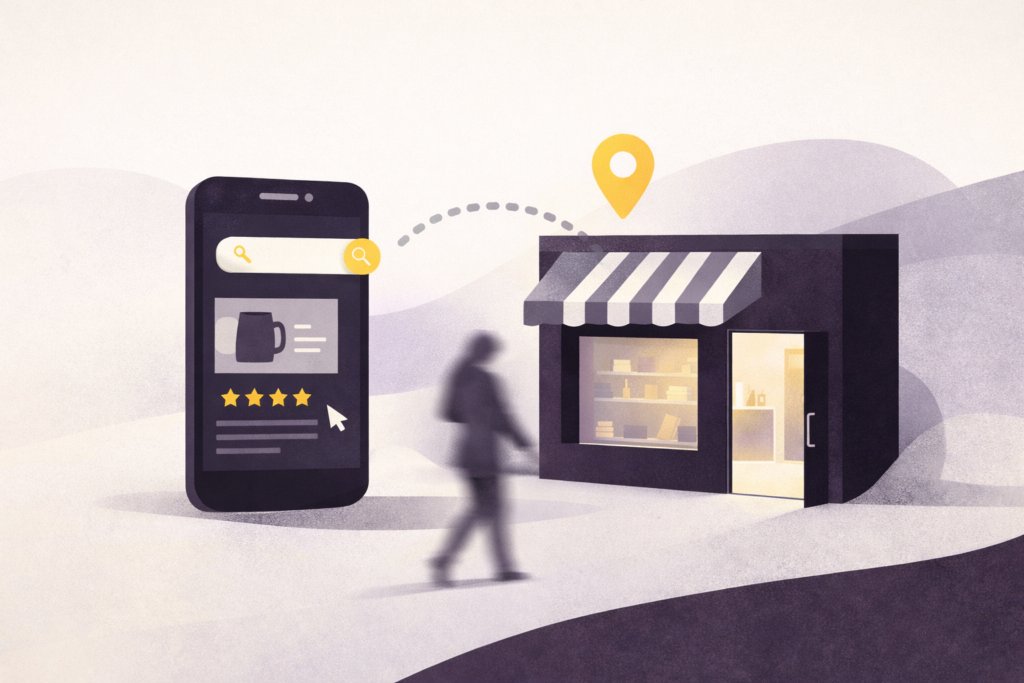


Retailers are increasingly asking the same question: how do we turn online interest into real‑world foot traffic?
While ecommerce continues to grow, physical retail remains critical, particularly for considered purchases, high‑value products, and brands where experience matters. The reality is that most in‑store visits today begin online. Customers research, compare, and form intent long before they walk through a door.
Recently, I spoke with AusBiz about how digital advertising and search behaviour influence in‑store visits, and what retailers can do to better connect online discovery with offline outcomes. The discussion explored why digital shouldn’t replace physical retail, but instead work alongside it.
Overview
- Most in-store purchases are influenced by digital research
- Digital ads shape intent, not just online conversions
- Retailers who align online and in-store experiences outperform those who don’t
Most in-store visits start online. Digital advertising shapes intent long before a customer walks through the door… answering key questions, guiding discovery, and setting expectations. Retailers that align their digital ads, online presence, and in-store experience are far more likely to turn online interest into real-world foot traffic and sales.
Watch: Digital Ads and the Return to In‑Store Retail
Key Takeaways for Retailers
1. Most in‑store journeys start online
Today’s “walk-in” customer rarely walks in cold. 2025 shopping statistics show that over 80% of shoppers research online before buying, even when the final purchase happens in-store. Search engines, digital ads, maps, social platforms and brand websites shape expectations long before someone steps through a physical door.
That behaviour matters because, while around 80% of retail sales are still expected to occur in brick-and-mortar stores in 2025, nearly one in five retail dollars is now influenced by ecommerce activity. Customers are checking availability, comparing prices, reading reviews, and deciding whether it’s worth the trip.
Retailers that don’t show up clearly, with accurate location details, strong search visibility, and consistent messaging, risk losing foot traffic before it even has a chance to form, no matter how good the in-store experience is.
2. Digital advertising influences intent, not just clicks
Digital ads aren’t only about driving online conversions. For many retail categories, they influence decision‑making rather than immediate purchases.
Search and paid media often answer questions like:
- Is this product available nearby?
- Where is the closest store?
- What does it cost?
- Is it worth seeing in person?
This matters more than ever, as 21% of all retail purchases took place online in 2025, while the majority still occur offline. Ads that support research behaviour, rather than pushing hard conversions, help move customers closer to an in-store visit.
When ads and landing experiences address those questions, they naturally guide customers to visit a store.
3. Alignment matters more than channel mix
One of the biggest gaps we see is misalignment between online messaging and in‑store reality.
When digital ads promise one thing but the in-store experience delivers another, whether that’s pricing, availability, promotions or service, trust erodes fast. And in a world where 70% of online shopping carts are abandoned due to friction, customers are increasingly intolerant of inconsistency.
Retailers that align:
- ad messaging
- local store information
- website content
- in‑store experience
…create far stronger outcomes than those focused purely on media spend.
In short, coherence beats complexity almost every time.
4. Digital and physical retail work best together
The strongest retail strategies treat digital and physical channels as complementary.
Digital helps:
- capture demand
- shape intent
- guide discovery
Physical stores then deliver:
- experience
- reassurance
- conversion
This complementary relationship is why omnichannel behaviours like click-and-collect are booming, with nearly 67% of customers making additional purchases when picking up in-store. Customers want flexibility; the convenience of digital with the immediacy and confidence of physical retail.
As e-commerce continues to grow globally (projected to hit $6.86 trillion in 2025), physical retail is evolving rather than disappearing. Retailers who connect these two worlds seamlessly are far better positioned to grow sustainably than those treating them as separate strategies.
Turning Digital Intent Into Real-World Results
As consumer behaviour continues to blur the lines between channels, the opportunity for retailers is clear: stop measuring digital solely by clicks, and start measuring it by its influence on real-world action. When digital and physical experiences are aligned, in-store traffic becomes more predictable, more qualified, and more valuable.
Read the Full Interview Transcript Here
Host:
Our next guest helps retailers turn online interest into in-store traffic, hopefully boosting sales and improving customer experience as well. To share why his clients want people back into stores, and how he’s attracting digital traffic back to physical locations, is Matthew Forzan from Yoghurt Digital.
So Matthew, explain Yoghurt Digital in your own words.
Matthew:
In my words, we’re a digital marketing agency. What makes us different is that we’re able to optimise the entire user journey, from where people start their search through to where and how they ultimately make a purchase.
Host:
A big focus at the moment seems to be getting people back into physical stores. Why is that so important for your clients?
Matthew:
For a lot of brands, these are considered purchases. People want to try something on, touch and feel the product, or speak to someone in person before they buy.
For other brands, it’s about the experience itself, walking into a store, being greeted by staff, and leaving with the product in hand. That in-store experience still matters enormously.
Host:
So how does digital play a role in actually driving people into stores?
Matthew:
One of the biggest levers is search. When someone searches for a product, the intent isn’t always to buy online. Often, they’re trying to find a nearby store, check availability, compare pricing, or decide whether it’s worth seeing in person.
To support that behaviour, brands need to show up in the right places with the right information. Store locations, opening hours, and availability messaging all need to be accurate and consistent.
Host:
What happens once someone lands on a retailer’s website?
Matthew:
Once someone lands on your site, the experience needs to support that intent. If a customer wants to visit a store, you don’t want to push them through an ecommerce checkout flow.
Instead, you should guide them toward store locations, directions, contact details, and set expectations around what they’ll experience when they arrive.
Host:
Where do paid media and digital advertising fit into this?
Matthew:
Paid media and digital advertising play a really important role, but they’re not always about immediate online conversion.
Often, they’re about influencing behaviour, capturing demand and guiding customers toward the next step, which might be visiting a physical store rather than buying online.
Host:
Measurement is always a challenge when it comes to in-store outcomes. How do retailers approach that?
Matthew:
Measurement is one of the biggest challenges. Driving in-store visits isn’t as straightforward as tracking an online purchase, but there are ways to connect the dots.
That might include location-based reporting, store visit metrics, local landing page engagement, or simply getting more disciplined about tying campaigns to store-level outcomes.
Host:
What’s the biggest mistake you see retailers make?
Matthew:
A lack of alignment. The message customers see online has to match what they experience in-store.
If pricing is different, stock isn’t available, or the service experience doesn’t line up with what was promised digitally, trust erodes very quickly. Digital and physical teams need to be working together.
Host:
What’s the big takeaway for retailers listening to this?
Matthew:
Digital shouldn’t replace physical retail; it should support it.
The strongest retailers use digital to capture demand, shape intent, and guide discovery. Physical stores then deliver experience, reassurance, and conversion. When those two worlds work together, retailers are in a much stronger position to grow.
About Yoghurt Digital
Yoghurt Digital is an Australian digital marketing agency specialising in SEO, UX, CRO, and performance-driven growth strategies for ambitious brands.
We work with retailers and multi-location businesses to connect digital discovery with real-world outcomes, helping brands capture demand, guide intent, and convert customers across both online and physical channels.
If you’re thinking about how your digital strategy supports in-store growth or want to better connect online discovery with offline outcomes, we’d love to chat.
Let’s make digital work harder for your physical retail performance.
This article features an interview originally aired on AusBiz.